First published on the club's members' blog in six parts, 27 July to 9 September 2020, and dated here to when the first part appeared.
Obedience first, because without it “all you have is an uncontrollable dog, which is a danger, especially when out hunting”. Keep lessons short, give one-word commands with a hand signal every time, and make the sound of a gun something good long before a pup hears a shotgun.
That is the advice of Leon Wright, who has been a duck hunter for nigh on 60 years and has hunted extensively in Australia and New Zealand. He has written for hunting magazines such as Sporting Shooter, Guns and Game, Australian Hunter and Australian Shooter for over 40 years. In 2020 he wrote a series for MRRA members about training and hunting with his Murrays, Missy and Cobber. This is that series in one place.
Obedience comes first
“The Murray River Retriever is a very intelligent dog and relatively easy to train. If I was asked what I considered the most important stage of training a dog I would say without hesitation, obedience, for without it all you have is an uncontrollable dog, which is a danger, especially when out hunting.”
Leon starts simple tasks, like sitting and coming when called, as soon as a puppy has settled into its new home, and keeps each lesson short: “no longer than 10 minutes at a time. These lessons can, of course, be held a few times a day.” He finds a pup from a hunting sire and dam easier to train than one from show lines, and tries to buy from hunting bloodlines where he can.
One word, and a hand signal
From the very first lesson, Leon pairs every command with a hand movement, because “your voice can carry a long way when out hunting especially when hunting over water, thus alerting game to your presence. If hand instructions are incorporated with verbal commands you will find after a period of time your dog will work just to your hand commands.”
“Your dog doesn’t understand English, so keep its instructions short with one word only and when issuing an instruction always use the same word, do not change it back and forth, you will only confuse the dog.”
Sit and stay
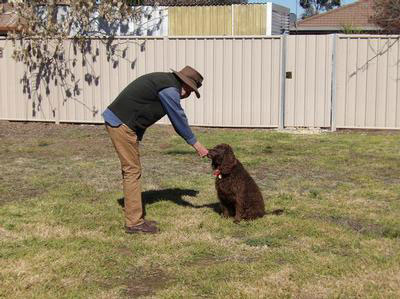
To teach SIT, Leon places one hand under the pup’s chin, pushes down firmly on its rear end and says SIT, with a treat each time it gets it right and a hand raised in the stop position as the signal: “eventually that hand signal will be all that is required to have it plant its butt firmly on the ground.”
Once SIT is reliable, he adds STAY: pup sits, the hand goes up in the stop sign, and he moves a short distance away, repeating the stop sign whenever pup starts to follow. It matters in the field:
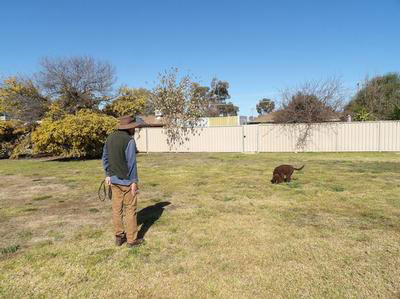
“When I am sneaking up to a dam wall after ducks I can get Missy to sit and stay about 20 metres from the dam while I continue on by myself. Missy will wait until I finish firing then come forward to retrieve any ducks I have taken, on command of course.”
Coming when called
Call the pup by name, say COME, and tap your leg as you do it: “in time the leg pat will be all you need.” Leon puts a young pup on a training cord at this stage: “If pup doesn’t respond to his name being called pull it towards you and then repeat the process.”
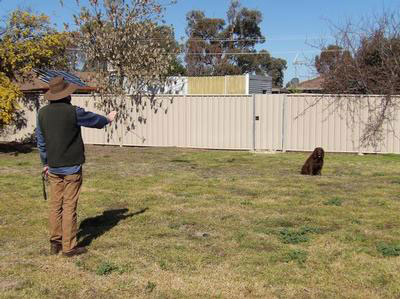
Avoiding a gun-shy dog
“Any time I hear a hunter bemoaning he has a gun-shy dog I immediately think to myself, it’s probably not the dog’s fault, you have done something wrong, like taking your pup out hunting far too young and firing a shotgun too close to it.”
Leon fires a cap gun every time he feeds his pup, far enough away not to frighten it, so the pup links the noise with “what it loves best, his tucker”. (Any noise will do, as long as it isn’t too loud.) Later, a friend fires a gun, preferably a .410, some distance away while you and the dog are out in the field; when the dog looks towards the shot, it gets a pat, praise and a treat. “Remember repetition is the key to success and keep the lessons short so as not to bore your dog, 10 to 15 minutes a lesson is ample.”
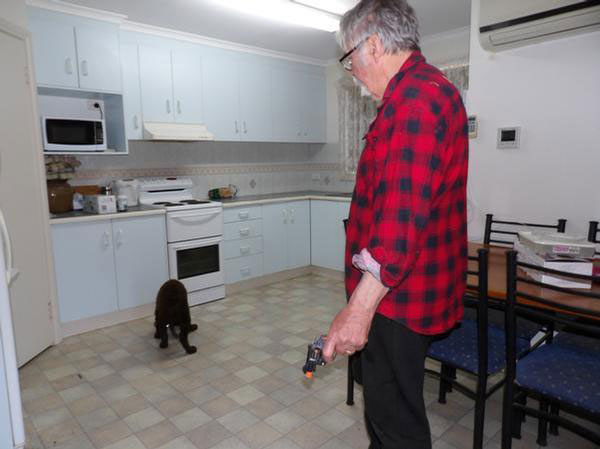
Walking to heel: when a Murray pulls
“Not all training goes as planned and Cobber and I are no exceptions.” Cobber had most things under control except walking to heel. After twirling a rope in front of his nose and constantly changing direction, all to no avail, Leon asked the club’s Registrar, Ken Jelbart, “who by the way is a far better trainer than me”:
“I’m not being quaint; a dog can’t pull if it has nothing to pull against. It is about a 3-minute exercise to teach the dog not to pull.”
When the dog starts pulling, yank the lead back, then let it go loose, tell the dog to sit, and start walking again once it has calmed down. Repeat whenever it pulls. “The dog will soon get tired of not going anywhere.”
Which side? Most hunters walk the dog on the right, Leon thinks because most are right-handed and it keeps them from shooting directly over the dog. Leon is left-handed, so Missy walks on his left, “for exactly that reason”.
Fences and dams: to jump or not to jump
Leon is strictly against a dog jumping a fence where he hunts, where fences are wire with barbed wire on top: “It is not a pretty sight if a dog gets tangled up on the top rung, barbed wire is a cruel lesson teacher.” Missy sits by the fence while he gets through, then he lifts the bottom wires and calls her through.
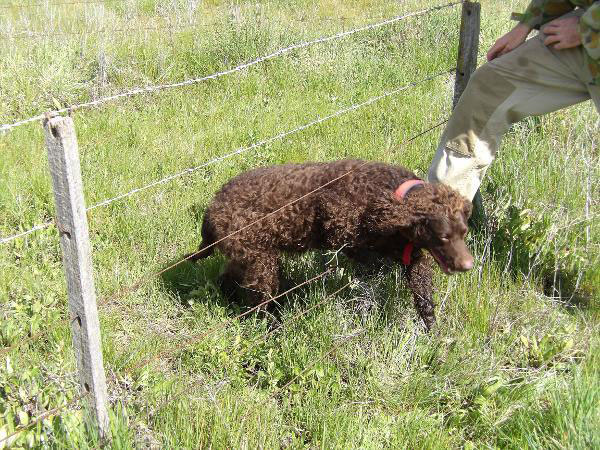
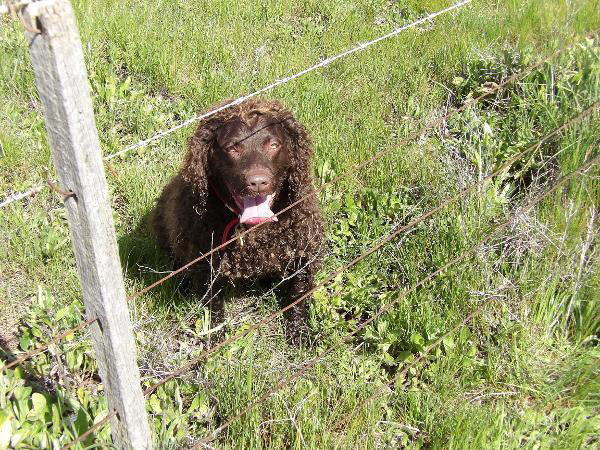
He also trains Missy to go into water slowly on a retrieve, especially on farm dams: in drought, farmers often fence dams off with star pickets and wire, and few remove the pickets when the dams fill again. “Not a pretty sight to see a dog impaled on a star picket after a massive leap into the water.”
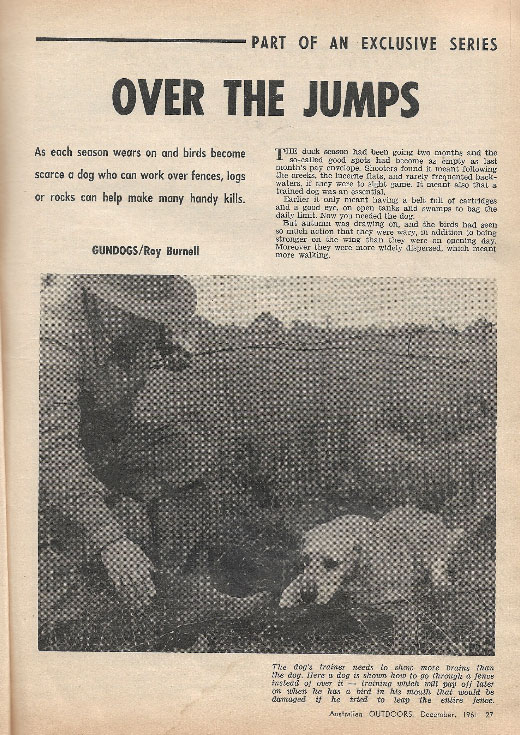
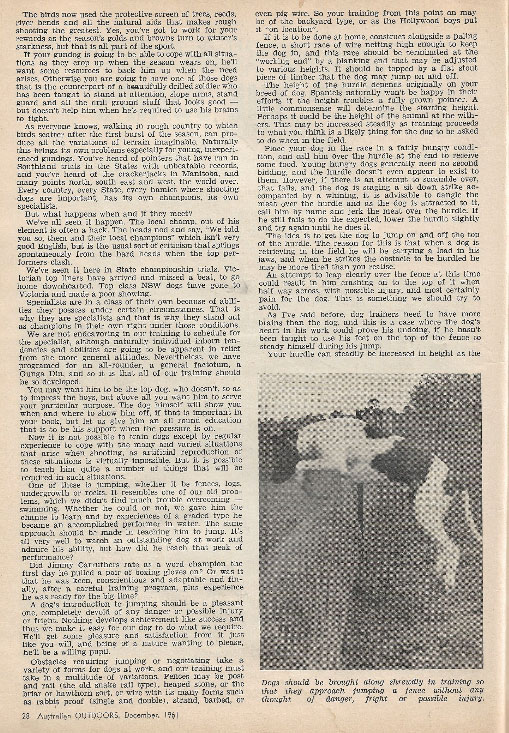
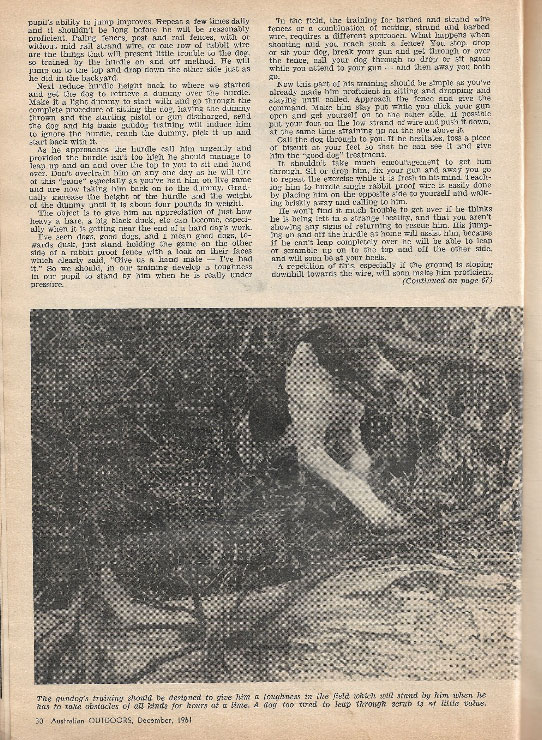
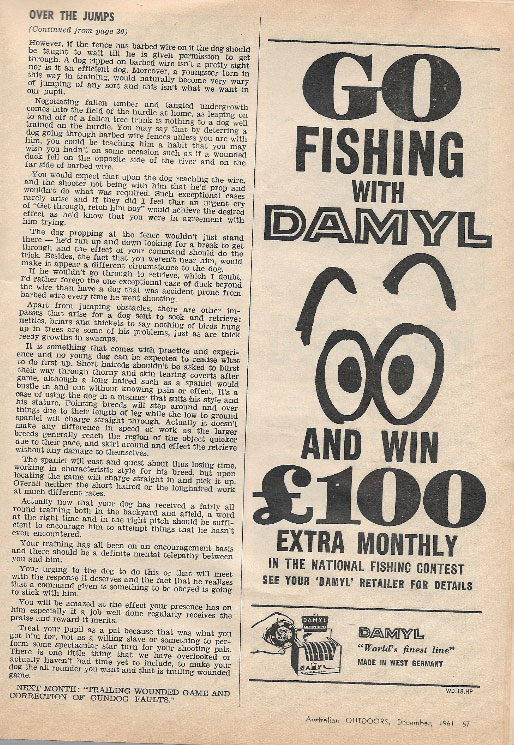
Where fences are stone, a dog does need to learn to jump. For that, Leon shared an article he rates as excellent: “Over the Jumps” by the noted trainer Roy Burnell, from Australian Outdoors magazine, December 1961. Here it is, with thanks.
In the field: ducks, deer and foxes
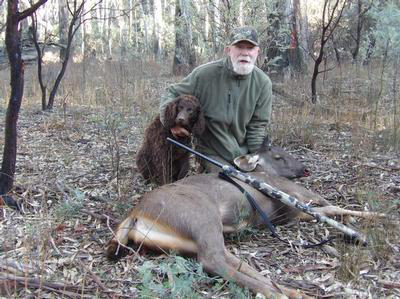
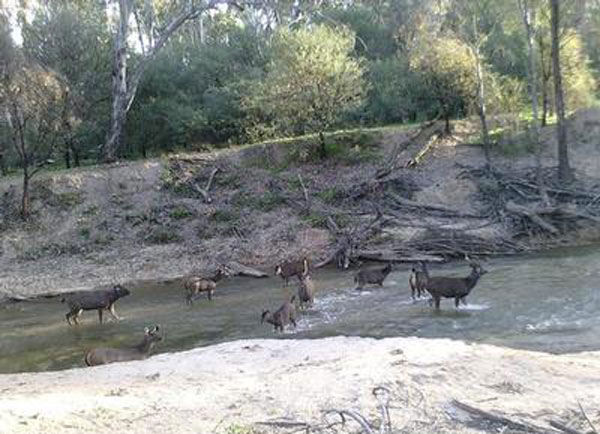
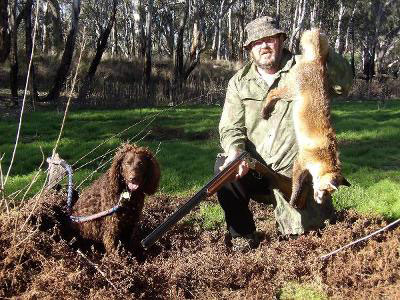
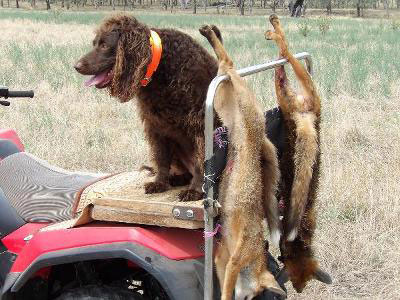
“Our dogs are very versatile, and will hunt all sorts of game. My Missy loves a hunt out on the deer … and she absolutely loves a fox chase.” In August 2020 Missy, Cobber, Leon and his brother Mick had a successful hunt after Sambar deer, “proving our Murray River Retrievers are indeed a versatile dog and can be used for hunting other species as well as ducks but I am pretty sure my Murrays prefer ducks above all else.”

Leon has also told the story of the club’s long fight to make it legal to hunt ducks with a Murray in Victoria, which finally succeeded in 2024: “In the doghouse”, for the Sporting Shooters’ Association of Australia (February 2026).
A fox hunt through tree windbreaks in September 2020 showed why obedience comes first. It ended early when Missy jumped on a large brown snake:
“It’s moments like these when you realise how important obedience training is. Missy came straight to heel when called. For a while there I thought the snake had bitten her but all ended well and she is fine.”
Key points
- Obedience first: it is what keeps a hunting dog safe.
- Short lessons (10 to 15 minutes), a few times a day.
- One word per command, always the same word, always with the same hand signal.
- Sit and stay lets you stalk ducks alone while your dog waits.
- Make gunfire a good thing: a cap gun at feeding time, then a distant .410 with praise.
- A dog can’t pull if there is nothing to pull against.
- Through wire fences, not over them, and slowly into farm dams.
By Leon Wright. First written for MRRA members in six parts, 27 July to 9 September 2020 (Training your Murray, parts 1 to 3, and Hunting with your Murray, parts 1 to 3). “Over the Jumps” by Roy Burnell is from Australian Outdoors, December 1961, and is reproduced with credit to the author and the magazine.